“We are what we repeatedly do. Excellence, then, is not an act, but a habit.” – Aristotle
This post is a record of what my average day looks like. I am preserving this moment in time such that as time passes, I see the changes. Also, I’m curious if in the future, my kids will wonder what I did all day.
As I have grown older, I have awakened to the power of daily habits. Mentors I have never met, such as Tim Ferris, Pete Adney, and Peter Attia all swear by building solid daily habits that over time will structure your life for success. I have adopted many of their suggestions along with experimenting with some of my own ideas.
I try to incorporate at least four elements into each day: 1) Quality rest including a comprehensive daily hygiene routine. 2) At least an hour, preferably two of physical activity. 3) Have at least one meaningful conversation with a friend or loved one 4) A small moment, of reflection and gratitude.
In that vein, here’s what an average day looks like for me in January 2026:
6:00 am – Wake up – within 15 minutes I typically get dressed, let the dogs out, feed them, make coffee, and start the fireplace in our living room. Coffee is a pour overdark roast served black. 6:15 – 7:00 – Ensure my kids are up for school. Read the WSJ and NYT. Take a moment to think thru my day and set some base line objectives for completion by end of day. 7:15 – 7:45 – Take W to school, same route most days though once in a blue moon I try a new route. Sometimes if I’m needing a break from the house, I stop for coffee at a local shop while on the way back home. 7:45 – 8:15 – Usually I walk the dogs a half mile while listening to podcasts on current events. Sometimes I take calls for work. All depends on the day. 8:15 – 10:00 – Depends on the day but I usually start work but if there’s not a pressing meeting or deliverable, I’ll opt to do my workout routine. In the past I ran eight miles daily, but lately I have cut the running down to 2-3 days per week with indoor cycling and lifting replacing that activity. I don’t know if it is aging or something else, but I miss the days when I was able to run my daily eight without feeling sore and beat up. 10:00 -1:00 PM – More work, usually in front of a computer writing, researching, reading, or zoom calls. Often I’ll workout during this period if I didn’t earlier in the day. Lunch is typically leftovers from the prior dinner. If not, I sometimes skip or just have a protein bar. On rare occasion, I meet a friend or colleague for lunch. Lately this has been my most productive part of the day. 1:00 – 6:00 – Reserved for meetings, networking, and/or low creative projects. This is a good time for busy work, not a good time for writing or deep thinking. Often I am on the phone or following up on emails and other messages. Sometimes if I’m training for an endurance event, I’ll take a late lunch and go for a 10 mile run. 6:00 – 8:30 – Usually reserved for family time. I tend to cook all of our meals which means I’m on my feet non-stop unless I have to run one of the kids to swim practice. 8:30 – 9:15 – Last run to the pool to pick up my youngest then back home to fix him dinner. 9:15-10:30 – Wind down. Clean the kitchen, watch TV, write in my journal, read, or hang out with my boys. On rare occasion, I’ll go back to work to line up my day for tomorrow. Afterwards I brush my teeth, put on PJs, lock the doors and go to bed.
Weekends are mostly the same with the exception that I try to workout longer and sleep in if possible. We travel 1-2 weekends a month, which means hotels and take out. I try to keep up the workout routine going. I love running in new places and have many memorable experiences from exploring places by foot.
Next month I’ll give some thought to things I’d like more of in my life and things I’d like less.
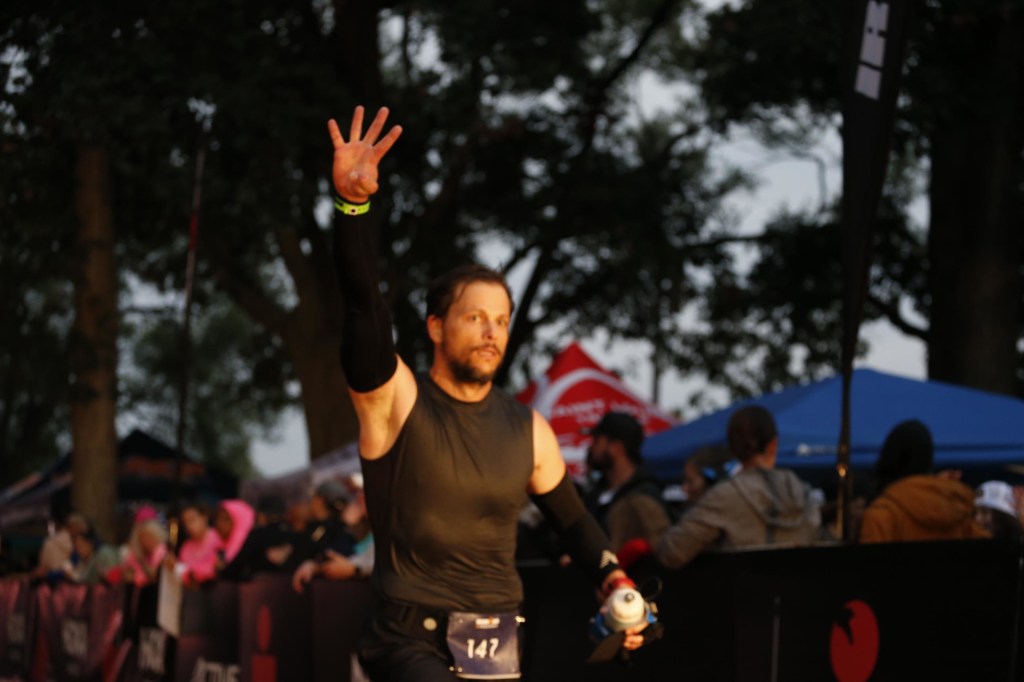
Here’s my recap of Ironman Indiana 2021. This is intended as a random collection of my own post race thoughts, non athletes and super dedicated tri-nuts might also enjoy reading it.
Why:
Uhm. . . I suspect everyone yesterday on the course was asking themselves this question at some point. My unofficial polling of my fellow athletes tended to fall into three buckets: 1) This is my umpteenth Ironman (aka lifestyle nuts) 2) This is a bucket list thing for me (aka everyman Everest) and 3) I was sick of sitting at home during COVID and this seemed like a good idea at the time (aka temporary insanity). I think I fell in the third bucket, though since I’ve done a couple of these stupid races, I suppose I’m straddling the line between #1 and #3. For those that don’t do these types of events and who might have a “one day” curiosity, I do recommend committing and signing up.
My life is more interesting and seemingly more balanced for having completed a few of these races. No, it won’t cure depression nor will it magically improve your looks and appeal to other human beings. You will get in better shape and watch less Netflix. But, there is something uniquely special about these events where you have to show up at a given time in a given place and perform. The magic is in the daily workouts for months prior to this event where you apply daily suffering in hopes of suffering less on race day.
For me, I signed up because I wanted to test if my normal life kept me in good enough shape for this distance. Also, I like having a very difficult thing on the calendar to get my lazy butt out of bed everyday. Somehow not having races on the calendar makes it easy to put stuff off.
The experiment:
I wanted to test if my daily running and a few days a week on the bike trainer were enough to finish under 12 hours. Short answer, Yes. My biggest volume of training leading up to this race was about 50 miles of running and about four hours on the trainer, so maybe 10-12 hours total. Most weeks I ran my usual 8 miles and two or three days a week I doubled up with an hour session on the bike trainer in the basement. My longest run was 13 miles and I did a single bike ride of 50 miles about a month before the race. I didn’t swim until the day before the race, which in retrospect was probably not wise.
My premise for this event was to see if my Tom Brady aged body combined with a good base fitness and 8-10 hours a week could get me to the finish line. Now I did have a nice solid base of aerobic training from a very hard spring marathon schedule where I was running 75-80 mpw for months that converted into a 1:28 half and 3:08 full back in April. I kept up that running but dialed back the MPW to 45-50ish. I’ve learned that the Ironman is really a hard marathon in disguise. The bike and swim are just a warm up to a marathon. If you can hold a steady pace and feel good on the run, these events are wonderful. If not, it’s a long f’ing walk.
Dumb things I did leading up to this event:
No swim training. Though I competed in swimming for 16 years and was a nationally ranked distance swimmer back in the day, I underestimated what happens to your swimming ability after 20+ years of not swimming. I’d always been able to finish the 2.4 under an hour but this time it took me longer as I kept running into other swimmers and my “line” was so crooked that I probably went a quarter mile further than needed. I did “man up” and swim without a wetsuit. Though I didn’t say it out loud at the race, I felt a sense of smugness looking at the other competitors who needed their “body floatation devices” to endure the 65F water. Bunch of babies.
Drinking beer and eating fried fish for 10 days about a month prior to the event. Now I wouldn’t change a thing or say the trip was a bad idea, I needed that week with my friends for my mental health, however it didn’t help with my readiness for this event. Prior to the fishing trip, my zone 2 run pace was finally starting to drop back in the mid 7s after weeks of sweaty/muggy runs in the mid to upper 8’s. I was starting to come into great conditioning in early Sept just before I stopped training for 10 days and put on six pounds of beer weight. Yeah. . .dumb.
Not doing yoga or other lower back stretches on a routine basis. Post race, there’s two things that I’m feeling the most: 1) chafing on my right bicep from where my tank top and arm warmer rubbed and 2) my lower back from six hours in the aero position.
Not riding my bike on real roads for more than 3 hours. My cycling was all over the place as I wobbled back and forth. I recall when I did my first IM, I was averaging nearly 200 miles a week riding everyday outside. My line was smooth, straight and my handling was great. Riding on a trainer in the basement might be an effective aerobic workout but it didn’t do squat to help me right a tight line on the road. For the first lap, I rode like a seven year old who just graduated from training wheels. Fortunately, by the second lap, muscle memory kicked in and I straightened out and found my line.
Smart/lucky things i did leading up to the event:
Good sleep habits. I got an oura ring back in January and it has helped me think about my sleeping habits. As a result I’ve managed to get a solid 8 hours a night for months and that seems to have done wonders for my recovery and mental health. Wind the clock back 5 years or so and I was a terrible sleeper (well I did have kids in diapers back then). But now I’ve made some subtle changes to my life that have led to better sleep like: consistently going to bed and waking up at the same time, avoiding alcohol and big meals after 8 PM, no caffeine after noon, and keeping the bedroom dark and cool. All relatively minor changes but they’ve had a dramatic net effect on my mental and physical being. Normally before the night before the race, I struggle to get sleep. Not so here, I checked into the hotel at 6PM and was sound asleep by 8:30 which gave me plenty of rest for when my alarm went off at 4:30.
Nutrition: Going into my last IM, I was much more disciplined about my diet, though I’ve kept about 90% of those habits leading into this event. Mostly I eat low carb high fat foods and I avoid grains and sugars. I also skip breakfast, opting for black coffee instead. Most days I just eat dinner. I can’t say this is the best formula for everyone but it fits wonderfully with my training (running in the am/lunch). During the race I stuck to a wonderful product called UCAN and it kept me going without any stomach distress. My first two ironmans were intestinal disasters. Gatorade and GU don’t work for me. I remember eating CLIFF bars off my bike frame and then then puking them up on the run. My system can’t process that crap, the keto/low glycemic stuff works for me so that’s what I do.
Perspective. I’m not a competitive athlete looking for a Kona slot nor was this my first dance at this distance. As a result I was able to keep the right mindset of “this is a challenge yet worthy part of my life.” I recall the time leading up to my first 140.6, that it was all consuming and I bled the ears off anyone near me about my training, prep, equipment, yadda yadda. This time, I think I mentioned it as dinner conversation a few times but tried not to focus on it. This might be the right approach and so far, works for me. Completing an Iron distance event is a significant achievement for anyone, however one needs to keep the perspective that it is a single day of exercise that all participants willingly volunteered to do,
Observations from the course:
I expected more corn fields and John Cougar Mellencamp. The route was very rural but only a few corn fields, mostly soy beans from what I could tell. The spectators along the course sometimes often had music, but I don’t recall hearing Small Town, Hurt so Good, or Pink Houses. Bummer.
The roads were in pretty good shape, though there was one fun freshly chip sealed section that everyone seemed to have strong opinions about. For the most part, the day was overcast with a slight wind from the south. I found it pretty easy to just stare at the white line and zone out for miles on end. I don’t remember a single hill or turn that stood out, though there was a choppy several mile stretch right before the finish on a former railroad that wasn’t very friendly to my derriere.
The run course was more rolling than I would have thought, though I can’t say I ever felt the hills. Weird thing to say but I run hills everyday so maybe I didn’t notice them as much. Most IMs have an out and back 6.5 mile route and this was no exception. This made it easy to know and mentally accept where you were on the course.
The competitors were all very nice and I didn’t seem to come across any alpha types who were out there to “crush all others.” FL and Coeur D’Alene both had a lot of those alphas, not so much in Muncie. To help pass the time on the run, I tried chatting up the people around me and everyone was willing to engage. Special thanks to Chad, Charlie, and some guy wearing a blue kilt.
No cell service anywhere near the event. Probably a good thing in general (I left my phone in the car anyways), but when you don’t know your way around and google maps won’t load, it added complexity to my planning that I was not prepared for.
I saw some interesting things along the route: An outdoor garden statue store that had a few different concrete sasquatches in various running poses. Had I stayed for the night after the race, I might have had to make a stop there on the way home. I ran over a dead snake on the run course just a mile past the dead racoon. The leaves were starting to fall from the early droppers like ash and hackberry. I suspect the area will be in full autumn in about two weeks, but we were a little early to catch the lower temps and fall colors. There were several giant power generating windmills near the bottom loop of the bike course. I still find the sight of those things somewhat awe inspiring, though the fact that they were turning meant I was having to battle the wind as well.
The stark contrast between the athletes and non-athletes was a bit jarring. In a place like Boulder Colorado or Coeur D’Alene, seeing a pack of lycra covered athletes riding $5k bikes around wouldn’t seem out of place. In Muncie Indiana, one rarely sees a 160lb spandex covered cyclist in the aero position flying past a local sporting a wife beater on his lawn mower drinking a beer.
Speaking of which, based on the data I gathered on a Saturday, it seems as most residents of middle eastern Indiana spend their time mowing grass and collecting wrecked cars. Not trying to stereotype here (I was raised in a similar part of the world), Since the bike course took me six hours and had two loops, I passed the same guy mowing his grass at 9:25, 11:15, 1:30, and 3:00. Looked like he was doing a good job from what I could tell, though he didn’t seem to own a string trimmer as the grass next to his car collection was a foot tall.
I managed to not drop a single water bottle on the bike course! Woo hoo!! It takes real skill to grab a water bottle from a volunteer at 15 mph while riding a bike and I did it four times without dropping it once. I was also 3 for 4 on hitting the garbage cans after emptying my bottles. One little surprise, when you grab a water bottle at that speed, it often causes the top to pop open and spray you with water. This caused a lot of water to spray on to my sun glasses but the fact that it was pouring rain seemed to negate that problem.
There are often many highs and lows during an IM and that is probably the greatest appeal of these races. One particular high for me was the chance to drink coke on the last 10 miles of the run. I never drink soda except during ultras or IMs. Wow, does real coke taste great when you haven’t had it for years.
I had my bike tuned about a month before the race. The mechanic put in a new bottom bracket (thing that connects the crank to the frame). Ever since I got home from the bike shop, that thing clicked on each pedal stroke. Not a deal breaker, but just annoying enough to bother me. So as the miles wore on yesterday, my bike clicked with each turn of the pedals. Then sometime around mile 70, it went silent and never made another noise. I guess it just had to be broken in or something.
I rented wheels again for the event. Not sure yet if it makes a difference, but it made my old Cervelo P2C look cool. One knock on RaceDayWheels, they didn’t have the banner up at the convention so I ended up driving to the reservoir just to find out that the wheel swap was back at the packet pick up in Muncie. I was about to complain to the guy but realized that he’d been on the road going from race to race for the past three months. I tipped him $20 and kept my complaints to myself. My bike performed flawlessly so all was good.
It rained pretty hard on the 2nd loop of the bike course. Surprisingly I enjoyed that part of the ride the most as it cooled things down a bit and allowed me to find my zen groove for the last 40 miles of the ride. As a life rule, I try to avoid complaining about the weather and instead take it in stride. Actually it’s more of a guideline than a rule because the humidity and temps kicked in about an hour into my run and I was eager to point that out to any sympathetic ears nearby.
Sometimes you just find yourself walking and you’re not sure how that happened. For the first 9 miles of the run, I was locked into my usual long run pace and was mostly zoned out with random thoughts coursing thru my head. Then rather suddenly, I was sweating hard and my pace was getting tougher to hold, within seconds I was walking. For those who have never found themselves in such a predicament, walking during an IM is a common and often good/bad experience. On the positive, your heart rate settles and you cool off a bit, plus it feels better on your feet and knees. On the negative, it doubles your finish time and makes miles seem very very long. It also is rather mentally crushing if everyone around you is still running. I think I got hot and my internal governor said walk and that was that. So I took it easy for about 30 min then started jogging here and there. Folks, that’s what happens when you show up to a race with only 8-10 hrs per week of aerobic training, you find yourself walking at some point on the run.
On a positive note, I held off on the sugar until the 2nd lap of the run and by then the temperature started to drop which gave me the courage to run again. Pretty soon I found my legs and ran for the rest of the race, I only stopped to pee and douse myself with ice and water at the aid stations. DId I mention how wonderful coca-cola is? I managed to pull myself out of my walking funk and to enjoy the last lap of the race.
This I think is what I enjoy most about these events. You find yourself somewhere when things start to go south. I knew a min into the swim start that a PR wasn’t in the cards that day. I also knew that a 3:30 marathon wasn’t happening after mile 1 of the run. But when I found myself walking with my head slumped down, I gave myself permission to cool off and reset. And it worked. I pulled through, smiled ear to ear, took big breaths, thanked the volunteers, and started running again. By the time I hit the finish, I felt great and was truly pleased that I entered in the race and stuck with it to the finish.
Things that I found annoying:
Mixing in with 70.3 athletes. This was the first time I’d done an IM that shared the course with halfers. If I do another full IM, it won’t be on a shared course. Though they started about 2-3 hours after us, we merged into each other on the 2nd lap of the bike course. This meant that I couldn’t quite zone out as hoped since the pace of halfers near me was about 1-2 mph slower so I was passing them frequently.
The transition area didn’t have a changing tent. While I didn’t need one, this was the first time that if you wanted to switch from a speedo to cycling bibs, you had to do it in front of everyone. In the past a volunteer would call out your race number and hand you your bag as you ran out of the water and into the transition tent. Also your transition bags were next to your bike which was good from a logistical standpoint however it meant getting geared up for the bike and run while next to a bike rack.
IMs are big events and are probably best for big cities. Muncie did a fantastic job with the scores of wonderful volunteers and support, however I think IM Louisville was a much more special and memorable event. That finish on 4th street live is just incredible and a life experience I won’t forget. The finish at Prairie Creek was nice too but it wasn’t in the same ballpark as IMCA or IMLOU.
The magic number of IMs you do before you stop buying swag at the convention is . . . 4. I usually pick up a bike jersey or jacket with the IM logo, but this time the prices were stupid. $139 for a white bike jersey with IM Indy on it? $100 for a hoodie? $40 for a t shirt, Forgetaboutit. . . I’m over the Ironman brand.
No Red Bull on the run course. I usually put one in my run special needs bag for the final 13 miles, however this time they said it would be on the course at the aid stations. . . not true!
Traffic around the start/finish. A single 2 lane road in and out. Not ideal for the 3000 competitors, volunteers and spectators.
The swim course. Sucked all the way around, would have been much better to have a single 2.4 mile loop versus a double 1.2. I suppose they do that for safety reasons but I can make a compelling case arguing against a double loop. I ran into the slower swimmers on the 2nd lap and spent the better part of my sunrise getting kicked and smacked around by other swimmers.
In conclusion, this was my fourth Ironman and as a mid 40ish guy, I still love the sport and will sign up for more events in the future. Second, I did minimal tri-specific training and still managed to have a middle of the pack performance. More importantly, I had a good time which should be the point of these activities. Not sure what life decisions led me to this situation, but at this point in life, I’m a marathon runner who dabbles in triathlons. That’s a huge change from twenty years ago when I was a distance swimmer who hates running.
Third, though Muncie did a great job pulling this event together, I doubt I’ll sign up for one here again. It was nice being able to drive home and sleep in my own bed after the race. However, an Ironman is a big deal and it would be more interesting to go to a more exotic destination like Alaska or New Zealand. Riding through the countryside in middle Indiana is fine for a weekend century with buddies, but not for a 140.6 race.
Fourth, I think the owners of the IM brand have diluted the experience since I first raced in 2008. Sure, the distance hasn’t gotten any shorter or easier. Yet, the prices for the swag and the corporate money grab feel of the promotions have cheapened the experience in a way I can’t describe other than to say, it feels less special. Maybe I’m an oddball here, but when it comes to endurance sports, I like the events to be at the ends of the spectrum. At one end, I love the small co-op feel of 50/100 milers ultras where the finisher award is a t-shirt and a bowl of homemade chili. At the other end are events like the Boston Marathon. An event where you run through the heart of major cities on closed streets while tens of thousands of spectators cheer you on. This latest IM fell somewhere in the middle, a memorable event but less special.
Regardless, I’m happy with the experience and I look forward to the next one.
 nzdiary.com